

The last week of February proved to be a scary one with a swift and steep sell off of global risk assets caused by the rapid spread of the Coronavirus, general uncertainty about its duration and the potential negative impact on global growth.
We want to provide some perspective on this market correction and what it means to your portfolio and financial plan in context of the bigger picture.
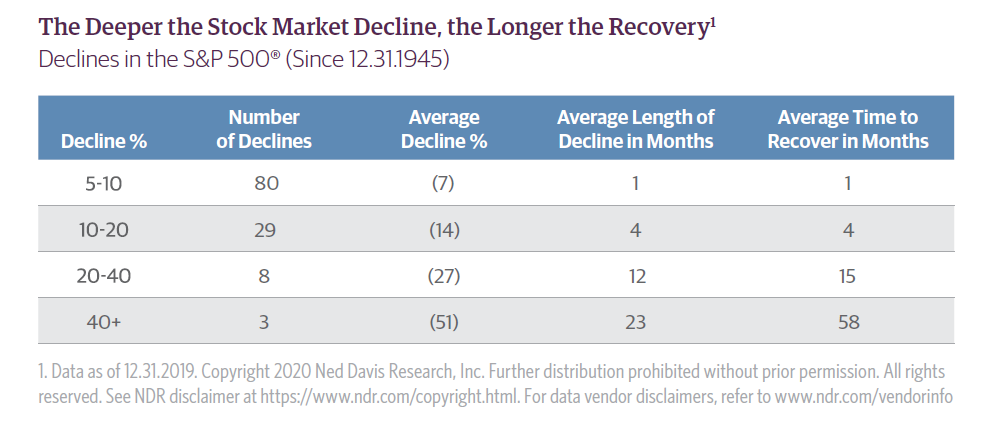
First and foremost, market corrections are normal and not all that uncommon. During the 75-year period since 1945 to current, there have been 120 market declines greater than 5% – or an average of 1.6 per year. As the chart below illustrates, the vast majority (90%) of declines are inside 20% and recover rather quickly. Far less often are there more severe declines of 40% or more which increases the recovery time significantly and have typically been during recessionary periods. Markets go up and go down, as you know, and declines can be emotionally taxing. What is important to understand is that markets do correct and historically recover.
It is important to remain calm and understand that your portfolios have been constructed to enable you to both emotionally and financially handle wild swings in the markets.
Emotional Impact and Behavioral Economics
We have spent time with you talking about risk and the expected behavior of your portfolio under both good times and bad times in an effort to understand your tipping point, or where your emotions may override your better judgement. We are still within the expected range of results we had modeled, but are always happy to re-group to re-assess whether those parameters are still within your comfort zone. A dress rehearsal is always different than the main act, so if you find you are having a difficult time coping with the negative news flow or checking your account balances daily, we’re here to talk and counsel you.
Financial Impact
Your portfolio is constructed to enable you to financially withstand current and future market declines. For those of you who do not need to draw from your investments, these market declines, while concerning, should not impact your financial well-being, as the value today matters far less than the value in the future when you anticipate drawing from your investments. Understand that the market cannot go up every day, and for the market to move higher over time it requires periods of market decline. Maintain faith in capitalism. Great companies continue to innovate and develop new products and services that the world wants and needs. These will be bought, owned, rewarded and become more valuable over time.
For those of you who are currently taking portfolio withdrawals, we have designed your portfolio with ample exposure to the safety of bond instruments to support your income needs when your risk assets are down. We have built in this flexibility to determine what we sell to raise cash for your withdrawal needs, provide your stock investments sufficient time to recover (refer to chart) in periods like this. Bonds have been a safe haven during this market rout, both appreciating in price and offsetting some of the declines in your equity funds. We are thus taking profit from the gains in your bond funds to meet your current cash needs and are not being forced to sell anything at a depressed value.
Risk reduction triggers
As we wrote in our 2019 year-end market pulse, we adhere to a rules-based process to systematically and proactively adjust the risk profile of your portfolio. This process is rooted in math and objective analysis, enabling us to put our emotions aside as we prudently manage the balance of risk and reward. As you can see from the above graph, the 5-20% declines generally are fleeting and tend not to cause irreparable harm to your portfolio, as such levels of decline recover rather quickly. What can cause irreparable harm is the declines in excess of 30%, since recovery takes exponentially longer, putting more pressure on your safer bonds to support your lifestyle for a longer period.
Our risk triggers typically start kicking in after a 15% decline. This level is designed for a couple of reasons. First, as 10% declines are quite common, they are also typically a level where buyers begin to emerge, causing a “V” shape recovery. You’ve heard of the saying “buy the dip”. Second, we want to be able to stay the course and not take big bets of being out of the market at the point historically buyers come back in to bid the market back up. This helps us mitigate the risk of selling low and buying higher.
You may recall back in December 2018 when the market last corrected, we began to trim your stock positions and accumulate cash between the market declining 15% and 20%. Had the market continued to decline, you would have already been positioned more defensively, and our process would also have continued to move more money to the sidelines. This process reduced exposure to risk assets but did not materially give up the reward side when the market bottomed and resumed its upward trend during the course of 2019. As we near the levels of decline we experienced in 2018, we anticipate our process will recommend the start of risk reduction measures should the market continue to decline in the upcoming weeks. We stand ready to proactively manage risk if the declines continue. Our process of managing risk will help us avoid full participation in those sustained declines of 30% + that do potentially damage the longevity of your investments since those extreme situations take a longer time to fully recover. This in turn should reduce the recovery time since we will limit the severity of the losses.
CONCLUSION
While we do recognize these are uncomfortable and unpleasant times, that uncertainty breeds fear, and fear has the potential to damage investor sentiment and drag the markets lower. However, we believe this too shall pass and we’ll be stronger on the back of this pandemic fear. Please keep calm and remember to wash your hands.
